Women In Health IT
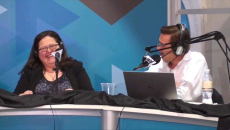
Brittany Wilson, BSN, RN, author and blogger of TheNerdyNurse.com, talks about her writings on nursing and technology and her impressions of HIMSS16 on HIMSS Radio.
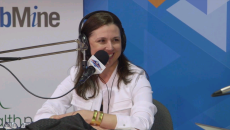
Mariann Yeager, Chief Executive Officer at The Sequoia Project, talks with Justin Barnes on HIMSS Radio about emerging trends at HIMSS16, especially around interoperability.
My mother had to go to work to support four children after my father died from cancer. I was active in the women’s movement in my college years. So, I can’t imagine women not having a career outside the home if they so choose or if they have to support themselves and their families.
National Coordinator Karen DeSalvo, MD, is stepping away from the co-chair role on the ONC Health IT Policy Committee.
Kathleen Blake, MD, vice president of performance improvement at the American Medical Association, will replace DeSalvo, according to Politico, which reported the announcement was made Tuesday at the joint meeting of the Health IT Policy and Standards Committees.
Blake will serve alongside DeSalvo's current co-chair, Paul Tang, MD, chief innovation and technology officer at the Palo Alto Medical Foundation. Tang is also the head of ONC's meaningful use workgroup.
[Also: How satisfied are you with your EHR? Satisfaction Survey results]
DeSalvo currently serves as both National Coordinator for Health IT and Acting Assistant Secretary of Health and Human Services. She's been with ONC since January 2014.
Health and Human Services Secretary Sylvia Burwell brought DeSalvo to HHS in October 2014 to help coordinate the federal government respond to the Ebola outbreak – touting her public health qualifications after having served as New Orleans Health Commissioner in the wake of Hurricane Katrina.
In May 2015, President Barack Obama appointed DeSalvo HHS Acting Assistant Secretary for Health. If she gets a Senate confirmation hearing and is approved, she would step down from the National Coordinator post at ONC.
Twitter: SullyHIT
Email the writer: tom.sullivan@himssmedia.com
Like Healthcare IT News on Facebook and LinkedIn

Rosemary Ventura, Director of Nursing Informatics at New York Presbyterian Hospital, discusses the organization's strategic emphasis on improving clinical workflows and mobility in nursing on HIMSS Radio, hosted by Justin Barnes.
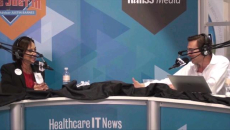
DeSalvo, Acting Assitant Secretary for DHHS, talks with Justin Barnes about some of the announcements made at HIMSS16 from the federal government and the agenda going forward.
Security chief Meredith Phillips says the health system reorganized internally to more effectively manage and secure 60,000 medical and Internet of Things devices, and to strongly position itself to handle evolving threats, such as ransomware.
The research also found that womens’ salaries grew at a higher rate than their male counterparts, while orthopedists, cardiologists, dermatologists are the highest-paid doctors.
Cinderblocks 3: The Partnership with Patients Continues is an art and medical conference that will be held in Grantsville, MD at Penn Alps Resturant and Little Crossings by The Cornucopia Café May 19-21, 2016.
Epic CEO Judy Faulkner talks EHR interoperability, need for a national patient ID, physician produc…
Judy Faulkner readily admits that when she founded Epic Systems she had no idea how to start a company.
Faulkner discussed those early years as well as some of today’s most contentious topics including semantic data interoperability, why the U.S. needs a unique patient ID, and the impact that electronic health records software has on physician productivity.
Semantic standards are key for data exchange.
If you're going to do interoperability between organizations, which I think is critical, it's limited because you have to define and normalize and harmonize the data so that each group can understand the other. Let's examine gender. I may have one for male, two for female, and then two other kinds of genders, ambiguous and something else.
[Also: Judy Faulkner: 'Good software is art.']
On the other hand, they may have one for female and a range of other values. How do you move that over when different groups have different ways of doing that? You need standards. There's a limited number of standards that we have to be able to transmit the data. I use such a simple example as gender, but as you go into the drug and other databases, there is even greater complexity. Within your organization you want to share. It's critically important to also get information back and forth from other groups who aren't yours.
Unique patient ID has to happen.
I think each person should have a medical identity. I don't care whether it's federal or not. However, the lack of this is not an excuse. You can do a lot of patient matching based on other attribute checking and so the identity would make it easier, but it is not an absolutely critical thing.
Remote care is the future.
Healthcare going to stay local to a great extent. I think it's going to also move to telemedicine much more than it is right now because we have to reduce the resources that we're using and the expense that we have in healthcare. Also people don't want to travel if they can help it. It will be a little slower than people would like.
Physician productivity among Epic's priorities.
Make sure your doctors are productive users. Focus on your doctors being productive users and all your users being happy. Because if that happens, then the rest will just fall out. Doctors happy, No. 1. And doctors happy means that they're taking good care of their patients, by the way, because doctors will not be happy if they're not, and I think that's really important, so I don't want to separate that out.
'I had no idea how you start a company.’
After I built it, I went around to a lot of different departments in University of Wisconsin and worked with them. One department had money for six months for a programmer to do something. There were only 20 data elements, and I remember charging them for 45 minutes of time. You can see why customers all around the country told people, ‘Look what they are doing." They'd call me up and say, "Start a company," and I would laugh and say, "No."
This went on for about two years. Finally I said ‘Yes.’ You have to realize I wore blue jeans. In the summer I wore T-shirts; in the winter I wore sweatshirts. I cut my hair with scissors, no makeup. I was a normal programmer and I had no idea how you start a company. So I went to somebody who had spun off from the university, and he said three things: One, get permission from the university, get a good lawyer, get a good accountant. I did all three. It was great advice.
I started the company, valued it at $70,000, and I invited my customers to join in and be part of the original shareholders. There are a lot of people then who helped start Epic … We divided it up, so if you had 5 percent of the company, you paid $3,500, and that got us started. We started with one and a half people. I had a morning assistant and an afternoon assistant. We were in a basement of an apartment house.
That was it. We signed a bunch of contracts and never took outside money from venture capital or went public or anything like that.
Twitter: @HealthITNews