Population Health
Robert Wood Johnson and NYU Langone tweaked processes to use social determinants, proactive screening and remote patient monitoring to reach goals.
Dave Chase puts forth contrarian viewpoints in his new book, and predicts that millennials will redirect the future of healthcare – which is a good thing.

Livongo CEO Glen Tullman explains that moves by businesses like Amazon and CVS are pushing the traditional healthcare system model because ready or not, consumers want to make their own healthcare decisions.

Jack Resneck, chair of the American Medical Association Board of Trustees, emphasizes the need for physicians to be involved in the early stages of app development to ensure they actually improve the overall care quality for patients.

Chris Pesce, chief operating officer at Sober Grid, talks about how the company won the Robert Wood Johnson Foundation opioid challenge for its mobile app integrating a peer support social network with certified and trained peer recovery coaches.
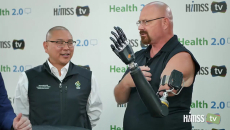
Albert Chi, MD, medical director of Muscle Integration at Oregon Health & Science University, and patient Johnny Matheny demonstrate how nerve reassignment and VR rehab work to advance prosthetic limb technology.
The global aging population may be straining resources, but could also be what pushes digital health innovations.
Data-driven partnerships with skilled nursing facilities helped the Ohio health system improve care outcomes and lower costs.
University of California San Diego researchers have created a new biometric technology they say could help securely identify children and and even newborns with just the wave of a finger.
The tech, funded in part by the Bill and Melinda Gates Foundation, is not yet commercially available, but UC San Diego researchers hope it will be within a year. They say it could be a help in many different scenarios: tracking vaccinations, delivering care during natural disasters, helping prevent human trafficking, resettling refugees and reuniting migrant children with their families.
The portable device, called ION, is a non-contact optical scanner. It enables imaging of fingers and palms, stored scanned prints as encrypted templates that can then be shared securely with laptops and mobile devices.
Previous biometric tools have unsuccessfully attempted to extrapolate adult technologies to fingerprinting children, but the UC San Diego innovation was to use human-centered design to develop the tool from the ground up with infants, caregivers and stakeholders in mind, said Eliah Aronoff-Spencer, MD, assistant professor of medicine, UC San Diego School of Medicine.
The tech was specifically created to accommodate the size, movements and behaviors of an infant. (It also works on adults.)
"Not only did we take into account the child's physiology and reflexes, but also what would be culturally acceptable in different countries," Spencer explained. "For example, in some areas, facial photography is shunned, but photography of hands is acceptable."
ION allows for "quick, accurate fingerprinting that may eliminate the need for paper identification and improve health care and security for millions," he said. "Globally, infant and childhood identification is needed for healthcare delivery, especially in remote or resource-limited areas, as well as for supporting efforts in disaster relief, human trafficking, migration and refugee settlement."
Other enhancements to the technology under development at UC San Diego include abilities to measure health biometrics and clinical data such as temperature, pulse, breathing and oxygen.
"Accurate identification of a child to enable timely vaccinations can improve care, reduce disease burden and save lives," said Spencer. "Imagine the ability to assist refugees displaced by war or natural disasters to establish their identity so they can access needed food, aid and care."
IRB-approved clinical trials are currently underway at UC San Diego and with collaborators in Mexico, and officials say early results have shown more than 99 percent accuracy on re-identification after registration as early as two days after birth, with 90 percent accuracy for registration on the first day of birth.
Researchers plan next to do further studies with the ION device in Africa and South Asia.
"We want to continue to validate the platform, work through workflow, security and ethical issues, and, with funding, make the technology available on a staged basis to non-governmental organizations and government programs at local and national levels," said Spencer.
.jumbotron{ background-image: url("http://www.healthcareitnews.com/sites/default/files/u1576/securityforjumbotron.jpg"); background-size: cover; color: white; } .jumbotron h2{ color: white; }
Healthcare Security Forum
The Boston forum to focus on business-critical information healthcare security pros need Oct. 15-16.
Twitter: @MikeMiliardHITN
Email the writer: mike.miliard@himssmedia.com
To VirtualHealth’s Sheela Ramamurthy, technology that works in the background to create a full picture of the patient will greatly impact the sickest, most vulnerable care populations.