Medical Devices
NSW Health will soon roll out a new radiology information system and picture archiving and communication system (RIS-PACS) across 11 of its organisations.
The organisations involved include nine local health districts, the Sydney Children’s Hospitals Network and NSW Health Pathology’s Forensic and Analytical Science Service, and aim to improve the way in which more than 1.8 million medical images are captured, used and archived across these organisations annually.
The deployments, the result of a partnership with Swedish-based secure communications company Sectra, are expected to take around three years to roll out and follow a six-month proof-of-concept trial.
Specifically, the platform provides more modern and improved services to patients, including SMS reminders for appointments and secure access to their images via an online portal.
Benefits to clinicians include: image accessibility to healthcare professionals working in different hospitals and in remote locations; critical results management and radiation-dose tracking; improved security of patient information; integration with other NSW Health systems; and access to prior images to assist with diagnosis and referrals.
The system involves a Sectra picture archiving and communication system (PACS), a radiology information system (RIS) provided by Kestral, and a critical result management system provided by Spok.
NSW Health said that with more than a million medical images captured by the participating organisations every year, images need to be stored safely and be readily accessible for clinicians.
“The new RIS-PACS platform will deliver benefits directly to patients by providing clinicians with improved access to imaging through a centralised image archiving and communication system,” it said.
[Read more: NSW’s hospitals enroute to state-wide Electronic Record for Intensive Care (eRIC) implementation | Innovation remains at the centre of eHealth NSW and HealthShare NSW's strategy]
eHealth NSW Chief Executive and NSW Health Chief Information Officer Dr Zoran Bolevich said the deployment is a “great example” of the collaboration between NSW Health and industry partners to deliver benefits across the state for both clinical staff and patients.
“The project placed key radiologists, ICT specialists and medical imaging users from 11 NSW Health organisations in the driving seat to test critical aspects of the platform prior to proceeding with a full implementation,” he said.
AMIA CEO Doug Fridsma says healthcare should simplify its approach to data exchange: keeping a laser focus on worthwhile use cases, sharing first and standardizing later, while also taking some cues from the basic APIs that power the World Wide Web.
One of the challenges with patient-generated data is figuring out how to use it for predicting future health events, says Mayo Clinic Medical Informaticist Dr. Karl Poterack.

At MEDinIsrael in Tel Aviv, Cynerio CEO Leon Lerman shares how his company keeps medical devices and hospital networks safe from cyberattacks.

Amir Inditzky, CEO of dayzz, talks about lessons learned from his company’s sleep app at MEDinIsrael 2019.
And in another AI collaboration announced this week, Siemens Healthineers is partnering with Intel to explore how machine learning can improve cardiac MRI diagnostics.

Cisco Systems is taking on the challenge of linking the enormous amount of data generated by EMRs as well as consumer and enterprise devices in the same clinical space, says Brendan Lovelock, health practice lead at Cisco.
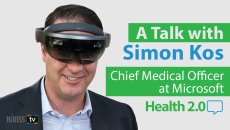
Looking to move healthcare systems out of the last century, the software giant is focusing on areas such as AI, population health, public cloud, precision medicine and virtual services, says Microsoft Chief Medical Officer Simon Kos.
The health system saved money by avoiding equipment purchases and reducing rental expenses; RTLS also saved it $300,000 and more than 10,000 staff hours annually.