Medical Devices
Unable to obtain the original blueprints for the valves because of medical manufacturing regulations, Cristian Fracassi and Alessandro Romaioli of Isannova reverse-engineered one, creating and testing three possible working prototypes.
Although going against established protocol, the team were able to produce 100 3D-printed valves in 24 hours and at a cost of approximately $1 per unit. This is in stark contrast to the $11,000 it costs Intersurgical, the patent holder, to make the CPAP Hood System, of which the valve is a small part.
The printed valves have already gone on to successfully treat patients in Brescia and another hospital has already got in contact with Fracassi and Romaioli for assistance. The team have not publicly released the designs, stating that they are working for free and believe, where possible, the valves should be produced clinically.
WHY IT MATTERS
L’Ospedale di Chiara in Brescia was unable to procure the valves from its regular supplier, who informed the hospital that they would not be able to make any more in time to treat the 250 patients already in their intensive care unit, as the increased demand due to the COVID-19 outbreak had cleared them out.
The valves are an essential component of breathing apparatus used to treat patients suffering from coronavirus, a virus that primarily targets the lungs and air-passages. They are single-use and designed to be used for up to 8 hours at a time, meaning the number of valves needed far outnumbers the Hoods.
THE LARGER PICTURE
Italy has suffered over 5,476 fatalities so far (23 March) from COVID-19, surpassing China as the country with the highest death rate. The virus seems to be affecting the country worst, with a Case Fatality Rate of approximately 8.3%, over double the estimated world average.
Intensive care units across the country have already been filled and the country is enduring a complete lockdown while essential services try and get the situation under control.
ON THE RECORD
Cristian Fracassi responded to his involvement in the project: “There were people with their lives in danger, and we acted. Period.”
He added: “If we acted fast, it was only because with 3D-printing you can quickly attempt a small production that would be impossible on an industrial scale,” before clarifying that the official valves were of a higher quality.
Michele Fiani, who also took part in the project, highlighted the importance of collaboration in this uncertain time: “I hope that all the people understand that we have to work together [to] stop this pandemic. All of us have to stay safe and have to use our skills to help [those] who need it”.

Health systems all over the world are using chatbots, drive-through clinics and telemedicine to address the needs of COVID-19 patients.
Program administered by The University of Hong Kong has international implications and applications; clinicians leverage wearables and AI to accelerate disease surveillance and interventions.
"Zero trust flips the security model: Instead of 'trust but verify,' organizations 'always verify but never trust,'" one security expert explains.
IoT security company Forescout has entered a strategic partnership with Medigate, a medical-device security and asset-management company, to help healthcare organizations continuously discover, identify, assess and secure all Internet of Medical Things (IoMT), IoT, operational technology (OT) and IT network connected devices.
Through this new collaboration, the companies have developed an integration to bring together Medigate's in-depth IoMT visibility, anomaly detection and lifecycle-management capabilities with Forescout’s enterprise-device visibility, automated segmentation and incident-response capabilities. Forescout will also resell the Medigate Platform.
WHY IT MATTERS
The joint offering will utilize passive technologies to identify and classify all connected medical devices and IT assets on health delivery organization networks, including unknown and hard-to-classify devices, while minimizing disruption. It will provide valuable insights to support corporate security policies to protect biomedical devices through effective vulnerability management, anomaly and threat detection, and risk scoring.
Through this partnership, healthcare customers will be able to design and implement effective segmentation and control access to the clinical network.
THE LARGER TREND
Last December, Medigate also partnered with EHR/EMR provider Cerner, which will provide hospitals more in-depth visibility, with continuous monitoring of network activity to create a detailed inventory of connected devices, HealthcareITNews reported.
Microsegmentation is one way to manage hard-to-secure connected medical devices through the creation of small, restricted segments of network. There are tools to help automate that process, said Jonathan Langer, co-founder and CEO, Medigate in an interview with HealthcareITNews in November 2019.
ON THE RECORD
“Connected medical devices represent a fast-growing threat attack vector and the lack of device manufacturer standardization and interoperability has created a significant problem for clinical care network operations,” said Pedro Abreu, Chief Product and Strategy Officer of Forescout, in statement.
“The combination of Medigate’s deep knowledge of medical devices and the healthcare industry with Forescout’s breadth of device intelligence adds a new level of cohesive device insight, expertise and security for the healthcare industry.”
Langer said: “The Medigate and Forescout partnership and integration provide healthcare organizations with rich contextual visibility into their IT and clinical networks, as well as sophisticated network analysis to detect threats and implement clinically-driven policies. These actionable insights will, in turn, reduce risk and improve patient safety.”
The new device, CarePort, is designed to allow caregivers to easily hook up with patients in their homes. The vendor's CEO eyes enabling senior citizens to stay at home, not the hospital.
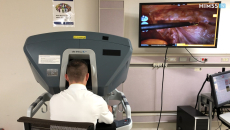
In the first edition of the HIMSS TV series "Assimilation," we take a tour of Inova Fairfax Hospital, where residents in training and physicians use operative simulators and immersive 3D to hone their surgical skills.
Healthcare providers and device manufacturers are both responsible for putting mitigations in place to address patient safety risks, says FDA's Suzanne Schwartz.
To prevent cybersecurity incidents, it is important to recognize the enormity and complexity of the problem, and to catalog various threats and vulnerabilities, as one infosec expert will show at HIMSS20.