Clinical
Lauren Ruane, co-head of Healthcare for J.P. Morgan’s Middle Market Banking & Specialized Industries, explains how the firm works to understand physicians' needs when developing financial tools and automating back office functions.
When is a virtual nurse needed? What are the skill sets required? What outcomes are hospitals seeing with virtual nursing? Lisbeth Votruba, RN, chief clinical officer at AvaSure, offers perspective.

Rachael Grimaldi, cofounder and CEO of CardMedic, explains how an app that supports clinicians in overcoming communication barriers at the point of care has empowered patients, such as those in perinatal care.
Virtual care has a big role to play in enabling better mental and behavioral health. Dr. Holly Dubois, chief clinical officer at Mindstrong, offers a look at a special telemedicine program designed to prevent suicide among veterans.

AHRQ is helping the transition towards evidence-based recommendations to guide clinical decision-making that incorporates patients' needs and preferences.
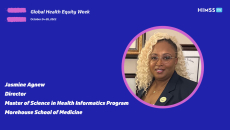
Jasmine Agnew of the Morehouse School of Medicine explains why. As the director of the school's Master of Science in Health Informatics Program, she says its IT instruction also factors in cultural competencies needed to capitalize on SDOH data.

Technology, clinicians and pharmacies all have key roles to play in dealing with the social determinants of health, say Iris Frye and Nicholas Christiano Jr., co-chairs of Health Equity Policy Task Force under the HIMSS Public Policy Committee.

Christopher Kunney, senior VP of digital transformation at Divurgent, explains how age-tech is being deployed for home care as primary care becomes virtual and accessed through nontraditional organizations.

Kim Clarke, assistant CIO at West Virginia United Health System, says even though more than half of WVU hospitals are in rural areas, all patients get the same level of care because of EMRAM Stage 7.

Dr. Nigel Spier, OBGYN and team lead for ModMed OBGYN, explains how adaptive technology can comprehend how physicians manage patients, based on their training and guidelines, and free them up to spend more time with high-touch patients.