Mobile Health IT
HIMSS Chief Technology and Innovation Officer Steve Wretling says developers need to build the experience healthcare hasn’t had yet.
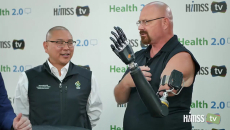
Albert Chi, MD, medical director of Muscle Integration at Oregon Health & Science University, and patient Johnny Matheny demonstrate how nerve reassignment and VR rehab work to advance prosthetic limb technology.
Microsoft and Vision Australia unveiled a new 3D audio app designed to give blind and vision impaired people greater independence to explore the world around them.
Dubbed Soundscape, the software enables users to set audio beacons at destinations and landmarks, and through a stereo headset the 3D audio is perceived as coming from the point of interest as they walk, allowing them to build a mental image of what’s around from the acoustic environment.
The app also calls out roads, intersections and landmarks, and was designed to be used in addition to mobility aids such as guide dogs and canes.
For David Woodbridge, Access Technology Advisor at Vision Australia, the app helps him to create a mental map of his surroundings.
“Soundscape gives me confidence in an outside environment by helping me understand what’s around me – whether it’s a restaurant, café, railway station, walking [or] bike track, park, business or even a street name. It allows me to build a mental map of my neighbourhood,” Woodbridge said.
The app provides more sensory information than traditional navigation maps that give directions.
“Rather than dictate what I should do, it allows me to make my own decisions based on the information it is providing, meaning I am always in control. For me, it really is about feeling stress free when I’m out and about,” Woodbridge added. “I have my own personal markers set for different locations. My local coffee shop is always a priority and the ‘coffee shop’ marker on Soundscape gets a lot of use.”
Microsoft’s Artificial Intelligence and Research team has been collaborating with Vision Australia for the last six months to test and integrate use of the app into the not-for-profit’s services for people with blindness and low vision.
More than one billion people live with disabilities worldwide but only one in 10 have access to assistive technologies and products. In Australia, 384,000 are blind or have low vision, with the number predicted to grow to 564,000 by 2030.
This article originally appeared on Healthcare IT News Australia.
Glen Tullman has served as the CEO of a major EHR vendor and the founder of a startup app maker focused initially on diabetes.
That background gives him a unique insight into the possibilities and constraints of each. For our Focus on Innovation, I spoke with Tullman about the foundation EHRs have created for the future of digital health, what to expect next from Livongo, and where he expects next-gen innovations to come from.
Q: You formerly ran Allscripts and now lead Livongo. Given that perspective, what’s your take on the innovation happening in so many corners of healthcare right now?
A: EHRs are fundamentally data repositories, so what do you need to do? You need to make them much easier for physicians to use on the front-end. On the back-end a lot of companies like IBM Watson and smaller startups are saying ‘we’ll take the data from the EHR and analyze it to give you real feedback on how to provide better care.’ But EHR vendors aren’t doing any of that innovation.
Q: We are seeing EHR vendors take steps to open their platforms to third-party developers and enable them to drive some of that innovation but is that the answer?
A: EHRs were an important step to get things digitized but they have not realized the promise of making it easier for physicians to deliver care and they haven’t been connected to each other. Why not? Technology-wise, they could be connected.
Q: Well, there’s a lot of innovation happening in healthcare and much of has little to with EHRs. Where is it all going?
A: The future of healthcare is not about big software systems in hospitals. That’s important but healthcare today is about how we empower people with chronic conditions, how we empower those people with software and technology to make it easier to be happier and healthier. Everything people can rip out of a hospital they’re ripping out of a hospital. Surgery centers, urgent care.
Q: In which case, what’s next for Livongo?
A: We’re going to release a cellular-enabled blood pressure monitor so we have hypertension data and give people real-time feedback outside the doctor’s office because 24 percent of people on meds actually have white coat hypertension instead of high blood pressure. Imagine if we could get them to check their blood pressure at home versus in the doctor’s office? It’s available now but the official release will happen at Health 2.0.
Q: And what about the broader industry, not just Livongo?
A: We’re going to see a lot of innovation. The world we’re talking about, tons of activity in digital health, making people smarter, helping them navigate the complex world of healthcare, making payments easier — that’s where the innovation is going to come from.
.jumbotron{ background-image: url("http://mobihealthnews.com/sites/default/files/u751/Innovation-month-jumbotron-1.jpg"); background-size: cover; color: white; } .jumbotron h2{ color: white; }
Focus on Innovation
In September, we take a deep dive into the cutting-edge development and disruption of healthcare innovation.
Twitter: SullyHIT
Email the writer: tom.sullivan@himssmedia.com
University of California San Diego researchers have created a new biometric technology they say could help securely identify children and and even newborns with just the wave of a finger.
The tech, funded in part by the Bill and Melinda Gates Foundation, is not yet commercially available, but UC San Diego researchers hope it will be within a year. They say it could be a help in many different scenarios: tracking vaccinations, delivering care during natural disasters, helping prevent human trafficking, resettling refugees and reuniting migrant children with their families.
The portable device, called ION, is a non-contact optical scanner. It enables imaging of fingers and palms, stored scanned prints as encrypted templates that can then be shared securely with laptops and mobile devices.
Previous biometric tools have unsuccessfully attempted to extrapolate adult technologies to fingerprinting children, but the UC San Diego innovation was to use human-centered design to develop the tool from the ground up with infants, caregivers and stakeholders in mind, said Eliah Aronoff-Spencer, MD, assistant professor of medicine, UC San Diego School of Medicine.
The tech was specifically created to accommodate the size, movements and behaviors of an infant. (It also works on adults.)
"Not only did we take into account the child's physiology and reflexes, but also what would be culturally acceptable in different countries," Spencer explained. "For example, in some areas, facial photography is shunned, but photography of hands is acceptable."
ION allows for "quick, accurate fingerprinting that may eliminate the need for paper identification and improve health care and security for millions," he said. "Globally, infant and childhood identification is needed for healthcare delivery, especially in remote or resource-limited areas, as well as for supporting efforts in disaster relief, human trafficking, migration and refugee settlement."
Other enhancements to the technology under development at UC San Diego include abilities to measure health biometrics and clinical data such as temperature, pulse, breathing and oxygen.
"Accurate identification of a child to enable timely vaccinations can improve care, reduce disease burden and save lives," said Spencer. "Imagine the ability to assist refugees displaced by war or natural disasters to establish their identity so they can access needed food, aid and care."
IRB-approved clinical trials are currently underway at UC San Diego and with collaborators in Mexico, and officials say early results have shown more than 99 percent accuracy on re-identification after registration as early as two days after birth, with 90 percent accuracy for registration on the first day of birth.
Researchers plan next to do further studies with the ION device in Africa and South Asia.
"We want to continue to validate the platform, work through workflow, security and ethical issues, and, with funding, make the technology available on a staged basis to non-governmental organizations and government programs at local and national levels," said Spencer.
.jumbotron{ background-image: url("http://www.healthcareitnews.com/sites/default/files/u1576/securityforjumbotron.jpg"); background-size: cover; color: white; } .jumbotron h2{ color: white; }
Healthcare Security Forum
The Boston forum to focus on business-critical information healthcare security pros need Oct. 15-16.
Twitter: @MikeMiliardHITN
Email the writer: mike.miliard@himssmedia.com
This is the first FDA clearance for Apple and pushes the Watch further into healthcare than ever before.
Executives explain how the developer initiatives work and why they’re fueling innovation and shaping future direction of their platforms.
The pregnancy app, developed in-house with some help, allowed the hospital to improve its OB-maternity HCAHPS by 68 percent – and cut printing costs for paper handouts by half.
Although the health system has been repeatedly dinged for lax security practices, most NHS hospitals aren't discouraging use of consumer messaging tools.
Studio H will develop digital tools and enterprise analytics technologies to innovate the healthcare experience for plan members.