Women In Health IT
The healthcare venture formed by Amazon, Berkshire Hathaway and JPMorgan Chase has hired insurance executive Dana Gelb Safran as head of measurement, a data-driven technology position, according to CNBC.
Safran is the chief performance measurement and improvement officer and senior vice president of Enterprise Analytics, at Blue Cross Blue Shield of Massachusetts.
She joins the Boston-based group headed by Dr. Atul Gawande.
WHY IT MATTERS
In her role at BCBS Massachusetts, Safran was responsible for leading efforts to use data, measurement, incentives, and reporting to improve the quality, outcomes, and affordability of care, according to biography information from the Medicare Payment Advisory Commission.
Webinar: Women in Blockchain: Making a Difference in Healthcare through Distributed Ledger Technology
Safran’s experience improving quality and outcomes while lowering the cost of care through IT is exactly how the industry views Amazon’s new venture and its potential to tackle healthcare’s greatest challenges.
Data and analytics will loom large, as will offering the 1-plus million employees of the three companies a personalized approach to healthcare benefits.
THE TREND
Not much has been released about the new venture, which the big three formed earlier this year. It still has no official name. Gawande was named CEO in June.
Safran’s background in health insurance, however, aligns with the innovations expected of Gawande, a Brigham and Women’s Hospital surgeon, author and New Yorker staff writer who, in the November 12 issue, sympathized with physicians struggling to balance EHR technology with work schedules and patient care.
DANA SAFRAN: THERE'S MORE TO KNOW
Safran was appointed to serve on MedPAC in 2017 in a term through April 2020.
She is also an associate professor at Tufts University School of Medicine. She serves on a number of state and national advisory bodies related to healthcare quality and affordability, including the National Quality Forum Consensus Standards Approval Committee and the CMS Technical Expert Panel on the Quality Rating System.
Twitter: @SusanJMorse
Email the writer: susan.morse@himssmedia.com
Business leader at Philips Wellcentive talks lessons learned and the future of value-based healthca…
Philips Wellcentive’s Business Leader Niki Buchanan also gives tips for women working in the health IT industry.
Innovation Factory’s Alaa Chalabi talks using wearables to detect sleep disorders and snoring habits at WISH in Doha, Qatar last week.
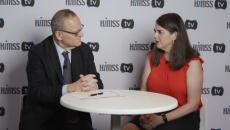
Jane Miller, COO of Royal Children's Hospital in Melbourne, Australia, shares that her organization, which reached the elite stage 7 EMRAM, treated EMR implementation as a clinical transformation project, not an IT project.

Robin Frady, executive director, B&CI Information Services at Grady Health System, talks about her organization’s success with using AI and data to target at-risk patients with post-discharge EMS outreach.
Both the clinician and the patient hold an important piece to the care puzzle, according to Kristina Sheridan, head of the enterprise strategy and transformation department at the nonprofit MITRE Corporation.
The physician has expertise in treating illness, whereas the patient is the authority on living with the condition, she explained at the Society for Participatory Medicine in Boston this morning. But transferring the patient’s life experience into a useable dataset can pose challenges.
“We hear about patient-generated data all the time,” Sheridan said. “But when you hear about the context of that data, most of the time right now it is around wearable devices and monitoring devices. … People aren’t talking about the other type of patient-generated data, what we call active patient generated data — the patient voice.”
Webinar: Big Data, Big Insight: A Conversation with Healthcare Analytics Leaders
Sheridan knows about the patient perspective from her own life experiences caring for her two children, both of whom contracted Lyme disease when they were in grammar school. This condition led to major complications for her daughter.
The symptoms of her condition became so overwhelming that her daughter started to think of them as the new normal and stopped mentioning them to doctors. That was when Sheridan put together an Excel spreadsheet to help keep track of her daughter’s symptoms.
“I finally had something to back up that gut feeling that something was off. When progress was slow and my treatment was plateauing, the data helped encourage me that things were still getting better,” Kate Sheridan, Kristina’s daughter who videoed into the session remotely, said. “But when things declined it was still beneficial to see. Sometimes between my myriad of symptoms it could be hard for me to identify and communicate exactly what was getting worse. Small changes in my condition could mean an infection or a bad reaction to meds and catching those symptoms prevented a trip to the emergency room. The data helped legitimize what I was feeling and gave me confidence in evaluating and communicating my own state of health. Data has power.”
This experience prompted Sheridan, a trained engineer in astronautics and space, to change careers. She now works with the research nonprofit MITRE to develop a digital Patient Toolkit, which lets patients digitally record symptoms, treatments and medications. It also lets patients communicate with their providers.
While she was inspired to get involved with patient data because of her personal journey, the Patient Toolkit comes from a slew of additional research. MITRE worked with the University of Virginia to listen to what patients wanted from a tool like this. The team found patients were mostly managing their own condition without digital tools, that patients wanted to be heard by providers and felt positively towards e-health tools.
The team also worked with Carnegie Mellon to listen to what providers wanted from patient generated data. The answer was longitudinal severity and compliance data.
Sheridan pointed out that most of the patient experience happens away from provider’s office. The toolkit was developed to remedy this gap.
“I don’t know any other experts who have no tool to support them in the 99 percent of time they are applying their expertise,” Sheridan said. “Patients are at home managing their own chronic condition the majority of the time, and they are in the clinic for [a small] amount of time.”
The toolkit was designed to help facilitate that patient input and let patients see their symptoms over the course of time.
“The best care is when patients are included and acting together,” Sheridan said.
MIT's Cynthia Breazeal is developing "social robots" that could help care for patient's emotional wellbeing.
Epic’s CEO encouraged women to forget the glass ceiling and use the fact that they are not men to their advantage.
To Health2047’s Lúcia Soares, the political climate has increased awareness around challenges and highlighted work that remains due to unconscious bias.