Government & Policy

At the HIMSS23 Healthcare Cybersecurity Forum, Nitin Natarajan, Deputy Director of the Cybersecurity and Infrastructure Security Agency, said protecting against escalating cyberattacks is a "joint effort" between government and the private sector.

The agency hopes the NPRM provisions will further move the needle on interoperability, expanding "appropriate access, exchange and use of electronic health information" with an eye toward health equity, said the National Coordinator for Health IT.

The partners will use natural language processing technology and de-identified EHR data better to help the agency research how medications affect large populations.

The Supreme Court's decision in Dobbs v. Jackson Women's Health Organization affected healthcare data and access, as well as other key privacy regulations, says Matthew Fisher, general counsel at Carium, in a preview of his HIMSS23 discussion.

The Coalition for Health AI's guide takes a patient-centric approach and aims to address, among other challenges, barriers to trust in AI and machine learning. It builds on the White House's AI Bill of Rights and NIST's' AI Risk Management Framework.
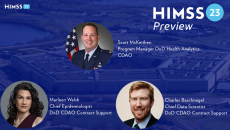
A HIMSS23 panel on biosurveillance to help public health officials in pandemics will feature Scott McKeithen, Marleen Welsh and Charles Baschnagel, who work at the Department of Defense Chief Digital and Artificial Intelligence Office.

Government and regional health authorities discussed challenges and ways to leverage cloud computing in accelerating digital transformation.

The agency says it is proposing a science-based approach to requirements for medical devices powered by artificial intelligence and machine learning that would help deploy new devices faster.


In response to the DEA, ATA stresses telehealth's efficacy in reaching previously unreachable populations, details the operational complications and confusion that will ensue, and requests to ease provider burdens.