Analytics
HIMSS16 Social Media Ambassador Geeta Nayyar: Analytics can harness the global power of social netw…
Geeta Nayyar, MD, is the chief healthcare and innovation officer at management services organization Femwell Group Health, the host of Topline MD TV, and the co-founder and chief medical information officer of design-based strategy and analytics firm Abeyon.
And at HIMSS16 she will join the ranks of Social Media Ambassadors credentialed to attend and cover the show. We asked Nayyar what she’s most interested in learning more about during the conference, her top health IT prediction for health IT in 2016 and the potential to apply analytics to social media to harness the power of massive networks around the world.
Q: What are you most excited to see at HIMSS16?
A: I’m looking for some very elegant user-centered design solutions. Too often the tech products we are putting out in the industry leave the end user’s (doctor or patient) point of view to the end. Keeping the tech simple and elegant can go a long way and with all the patient centered discussion and focus I’m looking to see this play out in more products. Also looking for other non-healthcare industry leaders to help show us lessons learned. The advantage healthcare has is we are so far behind many other industries such as retail and banking. To the extent some of these representatives will be at HIMSS I’m interested in hearing those use cases and extrapolating what they mean to healthcare. Also looking for use cases and proof points, whether that’s a pilot or real life scenario that has played out such that we can glean the lessons learned. And I’m very jazzed to be at HX360 this year. That forum seems ideal for all of the above. Lastly, I always love to see old colleagues and friends and connect in real time.
[Also: 21 awesome photos from past HIMSS conferences]
Q: What is something about you that even your devout followers don't know?
A: I’m a big tennis fanatic and love water sports of every kind. I have a boating license and love to sail and kiteboard.
Q: What is the untold benefit of social media in healthcare today?
A: Today, a large number of consumers turn to social media for health information, physician reviews and even data research, making the healthcare industry one of the top industries to attract large numbers of audiences from everywhere on the globe on social networks. I think we will see the analytics space growing around social media metrics and really help us understand what these networks currently are doing for patients and docs and what more can result from bridging massive networks across the globe.
Q: What’s your one health IT prediction for 2016?
A: The consumer continues to drive healthcare in 2016. As a result, I think we will see an uptake in telemedicine and remote monitoring solutions and communication solutions bridging docs and patients. I also think Big Data is only getting bigger — so we will see more solutions addressing how to better manage the data unfolding and put it into action.
Q: What inspired to apply to the Social Media Ambassador program?
A: As a former advisory board member of HIMSS I have always supported bringing different stakeholders in the industry together. With the Presidential campaign upon us we all know how relevant and timely the state of the healthcare industry remains. The Social Media Ambassador program allows us to bring these different views together and amplify them and make connections for all of those in industry looking for solutions to the universal problems we continue to face. Also, the program allows folks both present and not present to partake in this discussion and serves as an expansive network to count on both at HIMSS and after.
Twitter: @SullyHIT
This story is part of our ongoing coverage of the HIMSS16 conference. Follow our live blog for real-time updates, and visit Destination HIMSS16 for a full rundown of our reporting from the show. For a selection of some of the best social media posts of the show, visit our Trending at #HIMSS16 hub.
Atlantic Health cut operational costs $70 million in three years by effectively using predictive analytics, according to MaryPat Sullivan, chief nursing officer at Overlook Medical Center in Summit, New Jersey.
“We have so many IT tools in the hospital setting,” Sullivan said, “but they’re only good if they actually get adopted."
Overlook is part of the five-hospital Atlantic Health system. Sullivan spearheads healthcare literacy, diversity, and implementation of programs for pre-hospitalization, acute care and care transitions in the nursing department. When Overlook began its EHR transition, Sullivan’s team interviewed staff members to determine what data meant for them. While Sullivan thought culture change would hinder implementation, her staff actually embraced the transition.
[Also: 21 awesome photos from past HIMSS conferences]
“It’s a real find that staff were not only believing in the data, but were making decisions based on it,” she said.
Sullivan will deliver a presentation titled “Reining in Labor Costs with Predictive Analytics,” at HIMSS16 later this month.
Sullivan’s team spent a lot of time educating staff to help with the transition, she said, and found nurses felt “empowered to control their environment and to be good stewards to plan and evaluate.”
Her team used business analytics to predict hospital productivity and analyze labor costs. By comparing data from previous years, Sullivan could create the best possible schedules to reduce costs and get the most from her staff.
“We took the budget and the business analytics and married them,” Sullivan added. “It gives staff the control over their working environment and work in a way to maximize patient outcomes.”
Even though it’s only Atlantic Health System’s first year with the data, there’s already been a big reduction in overtime and premium usage.
See all of our HIMSS16 previews
“There’s a million moving parts to this, but in terms of data, we’ve seen a quarter of a day length of stay less, and earlier morning discharges,” Sullivan said.
Sullivan’s team is working toward the next steps of using the data to benefit the health system and apply the data concepts to other departments, like critical care.
The session “Reining in Labor Costs with Predictive Analytics” is scheduled for March 2 from 8:30 – 9:30 a.m. in the Sands Expo Convention Center Palazzo E.
Twitter: @JessiefDavis
This story is part of our ongoing coverage of the HIMSS16 conference. Follow our live blog for real-time updates, and visit Destination HIMSS16 for a full rundown of our reporting from the show. For a selection of some of the best social media posts of the show, visit our Trending at #HIMSS16 hub.
IBM executives say the purchase adds not only a massive repository of health data to the Watson Health Cloud, but also an extensive client roster to IBM's Watson Health unit.
To help information technology departments succeed at driving new projects, it takes viewing the IT team as partners, not roadblocks.
That’s the aim at Illinois-based Advocate Health Care, said Rance Clouser, the system’s vice president of IT field services.
Clouser, who leads unified communications and collaboration across the 12 hospitals and 250 care sites included in Advocate's campus, is also in charge of corporate support services, reporting and analytics.
See all of our HIMSS16 previews
During a HIMSS16 presentation, "Competing IT Priorities? Master Your Enterprise IT Demand," Clouser will discuss how Advocate achieved better outcomes on initiatives from social, mobile, analytics and cloud techniques, as well as infrastructure.
Clouser said that when projects are approached or denied, it's easy to paint IT as the bad guy, but business leadership should be making the big decisions and ensuring the IT department is heard.
His team has interviewed many organizations in the healthcare space and recognized Advocate wasn't alone in the need for portfolio management and interoperability.
When integrating processes over multiple institutions within one organization, it takes a lot of effort to get things just right.
"Apparently, I was pretty naïve when we started out, and I thought it could be done quickly," Clouser said. "Don't underestimate the effort."
Advocate’s leadership has allowed its separate sites to remain independent, Clouser said, and that independence in turn enables the communities to tailor their services to the needs of their region and demographic. But the individuality causes troubles with interoperability — an issue Advocate is currently trying to remedy.
"We've developed a system, fully in place to work with the business end, upfront, to make sure we're moving toward standardization and consolidation at each site," he added.
[Like Healthcare IT News on Facebook]
Due to Advocate's size, and the independence of the individual sites, Clouser said, it was imperative to meet with all staff members to learn the culture and needs.
Communication is also crucial to ensuring a successful implementation. "Communicate early, often and repeatedly,” Clouser said. “Because it just takes so long for a larger organization to adopt new processes."
The session “Competing IT Priorities? Master Your Enterprise IT Demand,” is slated to take place March 1, 2016, from 4 to 5 p.m. in Palazzo B at the Sands Expo Convention Center.
Twitter: @JessiefDavis
This story is part of our ongoing coverage of the HIMSS16 conference. Follow our live blog for real-time updates, and visit Destination HIMSS16 for a full rundown of our reporting from the show. For a selection of some of the best social media posts of the show, visit our Trending at #HIMSS16 hub.
Only a few days remain to submit speaker and session proposals for the Healthcare IT News and HIMSS Big Data & Healthcare Analytics Forum, which will be held in San Francisco June 14 and 15.
(SPONSORED) Technology has significantly disrupted the healthcare industry, creating a whole new matrix of threat and opportunity.
SPONSORED
 |
04:00 am |
February 15, 2016
|
04:00 am |
February 15, 2016
|
04:00 am |
February 15, 2016
(SPONSORED) The future of healthcare is already here. From automated insulin pumps to diagnostic instruments that can interpret their own results, today's medical devices are smarter and more sophisticated than ever. What's driving these innovations? The answer is data.
UPMC doctors are piloting a new program to administer gene tests to patients to determine whether they are likely to respond to medications.
For example, a simple blood test can determine whether a patient with clogged arteries has a gene variant that makes them less likely to respond to blood-thinning medication. At UPMC, doctors are testing for that gene before prescribing medications to patients who receive a stent.
With this pilot, UPMC is among first-mover health networks embracing genomics to improve patient care. NorthShore University Health System, for instance, earlier this year opened a pharmacogenomics clinic and is working to incorporate that data into patient records so clinicians can access what it called “systematic and discrete data points” when treating patients.
[Also: Pharmacogenomics coming to EMRs]
UPMC’s goal is to use clinical pharmacogenomics knowledge to individualize patient treatments – part of a broader program at UPMC that officials say could eventually include a wide variety of drugs to improve outcomes for patients.
"Increasingly we are able to pinpoint gene variations and other factors that affect how patients metabolize drugs, allowing us to more precisely target the right drug for the right patient," said Philip Empey, assistant professor of pharmacy and therapeutics at the University of Pittsburgh School of Pharmacy, and the leader of the program, in a statement.
[Like Healthcare IT News on Facebook]
The genetic and clinical information that is gathered for the PreCISE-Rx program, also feeds UPMC's data analytics program, which is expected to lead to new scientific insights into how and why drugs work for some patients but not others, and to identify new drug targets.
More than 700 patients are expected to be treated through this project at UPMC Presbyterian's cath lab in the coming year. Past studies show that 30 percent of patients are unlikely to appropriately metabolize clopidogrel (the blood thinning medication), and about 10 percent experience complications because of the blood thinner's ineffectiveness.
The UPMC research team will follow up with patients and collect data to evaluate their outcomes. UPMC plans to roll out the program at other hospital cath labs and expand it to include other medications.
Twitter: @HealthITNews
McKesson Health Solutions and Health QX on Wednesday announced an alliance designed to help insurers quickly design and scale complex bundled payment models. The agreement also aims to ensure those programs provide timely and accurate payment to providers.
Under the terms of the agreement, HealthQX and McKesson will jointly market their solutions to their respective customers, as well as coordinate consulting and service offerings, giving payers a single point of contact when creating bundled payment programs.
The announcement was made at the Healthcare Financial Management Association's annual National Payment Innovation Summit, which is being held this week in Memphis, Tennessee.
[Also: McKesson gears up for the next era]
The agreement unites industry leaders whose combined offerings start with claims analysis, using HealthQX's ClarityQX; it extends to enterprise-class operation using McKesson's Episode Management and its other value-based reimbursement tools. This closes the gaps that can derail bundled payment programs, as payers and providers define how payments should be administered or -- later -- as payers attempt to scale operations to enterprise levels.
[Like Healthcare IT News on Facebook]
The development is expected to be positive for payers and providers struggling to master the complexity of bundled payment models. Just last month, the Centers for Medicare and Medicaid Services implemented the final rule for its first mandatory bundled payment program. Starting in April, acute care hospitals in targeted regions will receive bundled payments for lower extremity joint replacements or reattachments. This aligns with CMS's goal of having 30 percent of reimbursement made via alternative payments this year, and 50 percent by 2018.
"Interest in bundled payment as a fast path to (value-based reimbursement) has never been greater, and payers and providers alike need help getting started and scaling up," said Carolyn Wukitch, senior vice president of McKesson Health Solutions, in a statement.
Twitter: @JELagasse
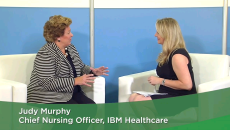
Judy Murphy, Chief Nursing Officer at IBM, discusses the growing influence of mobile technologies in healthcare analytics.