InterSystems
SPONSORED
 |
03:47 pm |
June 16, 2022
|
03:47 pm |
June 16, 2022
|
03:47 pm |
June 16, 2022
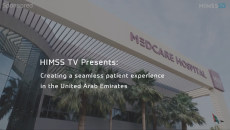
Find out how Medcare's partnership with InterSystems in the UAE has propelled the organization's mission to provide clinical innovation through technology - while driving standards and patient safety.
SPONSORED
|
12:57 pm |
May 02, 2022
|
12:57 pm |
May 02, 2022
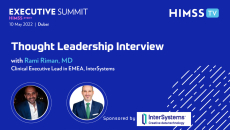
Analytics tools can help efficiently extract and share HIE data, which leads to informed clinical decisions that can drive improved patient outcomes, says Dr. Rami Riman, director of clinical and business improvements in EMEA for InterSystems.
SPONSORED
|
03:34 pm |
April 12, 2022
|
03:34 pm |
April 12, 2022
The adoption of new technology has helped Abu Dhabi's Capital Health hospital improve clinical outcomes, drive business efficiency and empower the workforce. See this virtual tour from the United Arab Emirates.

SPONSORED
|
04:15 pm |
October 26, 2021
|
04:15 pm |
October 26, 2021
InterSystems' Ali Abi Raad discusses the main benefits of a cloud-hosted EMR solution versus a regular EMR, and how the company is assisting with travel technology during the COVID-19 pandemic.

SPONSORED
|
11:46 am |
October 19, 2021
|
11:46 am |
October 19, 2021
Dr. Lloyd McCann, CEO of Mercy Radiology and head of digital health for Healthcare Holdings, discusses how shifting to value-based care benefits patients, clinicians and the organization as a whole.

SPONSORED
|
10:24 pm |
October 10, 2021
|
10:24 pm |
October 10, 2021
In an interview with HIMSS TV, Dr Lloyd McCann, CEO of Mercy Radiology and Clinics, and Head of Digital Health for Healthcare Holdings Limited, explains how digital transformation is central to the Auckland provider’s drive to become a mature analytics organisation and deliver innovative value-based care.

SPONSORED
|
05:35 pm |
September 14, 2020
|
05:35 pm |
September 14, 2020
Alexander Ihls, business development manager at Healthcare DACH, InterSystems, discusses AI application in radiology and how artificial intelligence is helping radiologists.
SPONSORED
|
06:23 pm |
January 28, 2020
|
06:23 pm |
January 28, 2020
Digital health requires a healthy data pipeline that’s aggregated, normalized, and deduplicated, and ready to be integrated into workflows across the health ecosystem for care coordination, analytics and machine learning.

SPONSORED
|
06:30 pm |
November 25, 2019
|
06:30 pm |
November 25, 2019
In this virtual tour of Mediclinic Middle East, learn why key stakeholders from doctors to allied health professionals must be involved in the selection and customization process of the EHR to ensure optimum engagement.
SPONSORED
|
01:00 am |
October 30, 2019
|
01:00 am |
October 30, 2019
In most industries, change or evolution isn’t a gradual process. You might have years and years of equilibrium, with little improvements here and there, and then all of a sudden a massive technology and/or business model change takes us to a new level.
For example, the taxis of 1950 looked a lot like the taxis of 2010. Then along came ride-sharing apps. Now, as we look forward to self-driving cars, I would say that the “rent-a-ride” market is in the middle of an explosion of rapid change – how it will end, we don’t know.
Looking at how technology has changed the healthcare industry, I would argue that we have already had one explosion of rapid change, and we are in the middle of a second one now.
When my career started, we wrote billing systems – systems with structured data, typed in on numeric keypads, by dedicated users of the computer. This was the first generation of success in health IT, and it digitised the administrative parts of healthcare.
Then a number of technology breakthroughs happened – standardising on SQL databases, the storage and viewing of text and images, and perhaps most importantly, the graphical user interface. This allowed non-dedicated users, like physicians, nurses and patients, to use software to help them with their work and lives. This ushered in the next couple of decades where we built and deployed electronic medical records (EMRs).
Now health IT is in the middle of a second explosion of rapid change. This disruption to healthcare offers the promise of even bigger benefits – with improved outcomes and reduced costs – than we have seen with digitisation to date.
If you look at the disruptive technologies of today: cloud, artificial intelligence (AI), wearables, imaging/text analytics, advanced interoperability and ubiquitous user experience (UX), we have the raw ingredients for this next massive change. And if you examine that list, not one of those technologies has reached its full potential yet. They are all showing promise, but most importantly, they are incredibly promising as we explore the various use cases where they can help.
The history of InterSystems has mirrored this trajectory. Our initial database technology enabled the major billing systems of the original health IT market. A couple of decades ago, we launched our Caché product line and enabled the major EMRs in the market today, including Epic, and our own EMR TrakCare. Last year, in line with this current explosion of rapid change, we launched our next platform, InterSystems IRIS for Health, to bring capabilities for this current explosion of rapid change – cloud, AI, API interoperability, analytics – to our customers. And some of our customers are already embracing these capabilities to change the way they support the healthcare industry.
Earlier this year, MediWay Technology, one of the largest healthcare software companies in China, deployed its new iMedical Cloud healthcare IT ecosystem platform using IRIS for Health. This allows MediWay’s iMedical healthcare information system (HIS) to support all stakeholders in the Chinese healthcare system – including government, healthcare organisations, and consumers – in an environment where medical reform policies are driving increased collaboration, information sharing and use of big data.
Two iMedical Cloud applications, hosted on Tencent Cloud, were launched – transactional cloud collaboration (Cloud HIS) and data cloud collaboration (HealthChain). These can be used within a region for real-time healthcare information exchange, centralised management control and unified allocation of resources. Built and deployed on a unified data platform, iMedical Cloud supports the vastly increased data volumes required with features like sharding. This distributes data across a number of cloud-based servers to provide flexible, inexpensive performance scaling.
On the other side of the world in New York, HBI Solutions is using machine learning and predictive analytics to convert vast amounts of data into knowledge that can be applied in real time to decision support. Healthcare providers see not only their patients’ pasts, but also their likely futures. HBI’s Spotlight Data Solution identifies elements, or “features”, in health records that could indicate future problems.
What’s exciting about being in the middle of a period of rapid change is you don’t know how it will turn out. What is quite clear, based on the enabling technologies of this era, is that we are moving closer and closer to the patient, and closer and closer to being helpful to the clinicians and not just an administrative sidekick.
Health IT has had a long and illustrious history digitising healthcare. But now we are about to create an even better future. I can’t wait to see what we build together.
Are you looking for someone who you can talk to about your own rapid changes? Take the next step here.
About the Author
As Vice President, InterSystems HealthShare, Don Woodlock oversees a family of products created to empower the transformation of health and care through comprehensive, shared health information. In his role, Woodlock is responsible for advancing the HealthShare vision to meet the challenges associated with delivering improved quality, accessibility and efficiency across the health and care industries.