Analytics
To help information technology departments succeed at driving new projects, it takes viewing the IT team as partners, not roadblocks.
That’s the aim at Illinois-based Advocate Health Care, said Rance Clouser, the system’s vice president of IT field services.
Clouser, who leads unified communications and collaboration across the 12 hospitals and 250 care sites included in Advocate's campus, is also in charge of corporate support services, reporting and analytics.
See all of our HIMSS16 previews
During a HIMSS16 presentation, "Competing IT Priorities? Master Your Enterprise IT Demand," Clouser will discuss how Advocate achieved better outcomes on initiatives from social, mobile, analytics and cloud techniques, as well as infrastructure.
Clouser said that when projects are approached or denied, it's easy to paint IT as the bad guy, but business leadership should be making the big decisions and ensuring the IT department is heard.
His team has interviewed many organizations in the healthcare space and recognized Advocate wasn't alone in the need for portfolio management and interoperability.
When integrating processes over multiple institutions within one organization, it takes a lot of effort to get things just right.
"Apparently, I was pretty naïve when we started out, and I thought it could be done quickly," Clouser said. "Don't underestimate the effort."
Advocate’s leadership has allowed its separate sites to remain independent, Clouser said, and that independence in turn enables the communities to tailor their services to the needs of their region and demographic. But the individuality causes troubles with interoperability — an issue Advocate is currently trying to remedy.
"We've developed a system, fully in place to work with the business end, upfront, to make sure we're moving toward standardization and consolidation at each site," he added.
[Like Healthcare IT News on Facebook]
Due to Advocate's size, and the independence of the individual sites, Clouser said, it was imperative to meet with all staff members to learn the culture and needs.
Communication is also crucial to ensuring a successful implementation. "Communicate early, often and repeatedly,” Clouser said. “Because it just takes so long for a larger organization to adopt new processes."
The session “Competing IT Priorities? Master Your Enterprise IT Demand,” is slated to take place March 1, 2016, from 4 to 5 p.m. in Palazzo B at the Sands Expo Convention Center.
Twitter: @JessiefDavis
This story is part of our ongoing coverage of the HIMSS16 conference. Follow our live blog for real-time updates, and visit Destination HIMSS16 for a full rundown of our reporting from the show. For a selection of some of the best social media posts of the show, visit our Trending at #HIMSS16 hub.
Only a few days remain to submit speaker and session proposals for the Healthcare IT News and HIMSS Big Data & Healthcare Analytics Forum, which will be held in San Francisco June 14 and 15.
(SPONSORED) Technology has significantly disrupted the healthcare industry, creating a whole new matrix of threat and opportunity.
SPONSORED
 |
04:00 am |
February 15, 2016
|
04:00 am |
February 15, 2016
|
04:00 am |
February 15, 2016
(SPONSORED) The future of healthcare is already here. From automated insulin pumps to diagnostic instruments that can interpret their own results, today's medical devices are smarter and more sophisticated than ever. What's driving these innovations? The answer is data.
UPMC doctors are piloting a new program to administer gene tests to patients to determine whether they are likely to respond to medications.
For example, a simple blood test can determine whether a patient with clogged arteries has a gene variant that makes them less likely to respond to blood-thinning medication. At UPMC, doctors are testing for that gene before prescribing medications to patients who receive a stent.
With this pilot, UPMC is among first-mover health networks embracing genomics to improve patient care. NorthShore University Health System, for instance, earlier this year opened a pharmacogenomics clinic and is working to incorporate that data into patient records so clinicians can access what it called “systematic and discrete data points” when treating patients.
[Also: Pharmacogenomics coming to EMRs]
UPMC’s goal is to use clinical pharmacogenomics knowledge to individualize patient treatments – part of a broader program at UPMC that officials say could eventually include a wide variety of drugs to improve outcomes for patients.
"Increasingly we are able to pinpoint gene variations and other factors that affect how patients metabolize drugs, allowing us to more precisely target the right drug for the right patient," said Philip Empey, assistant professor of pharmacy and therapeutics at the University of Pittsburgh School of Pharmacy, and the leader of the program, in a statement.
[Like Healthcare IT News on Facebook]
The genetic and clinical information that is gathered for the PreCISE-Rx program, also feeds UPMC's data analytics program, which is expected to lead to new scientific insights into how and why drugs work for some patients but not others, and to identify new drug targets.
More than 700 patients are expected to be treated through this project at UPMC Presbyterian's cath lab in the coming year. Past studies show that 30 percent of patients are unlikely to appropriately metabolize clopidogrel (the blood thinning medication), and about 10 percent experience complications because of the blood thinner's ineffectiveness.
The UPMC research team will follow up with patients and collect data to evaluate their outcomes. UPMC plans to roll out the program at other hospital cath labs and expand it to include other medications.
Twitter: @HealthITNews
McKesson Health Solutions and Health QX on Wednesday announced an alliance designed to help insurers quickly design and scale complex bundled payment models. The agreement also aims to ensure those programs provide timely and accurate payment to providers.
Under the terms of the agreement, HealthQX and McKesson will jointly market their solutions to their respective customers, as well as coordinate consulting and service offerings, giving payers a single point of contact when creating bundled payment programs.
The announcement was made at the Healthcare Financial Management Association's annual National Payment Innovation Summit, which is being held this week in Memphis, Tennessee.
[Also: McKesson gears up for the next era]
The agreement unites industry leaders whose combined offerings start with claims analysis, using HealthQX's ClarityQX; it extends to enterprise-class operation using McKesson's Episode Management and its other value-based reimbursement tools. This closes the gaps that can derail bundled payment programs, as payers and providers define how payments should be administered or -- later -- as payers attempt to scale operations to enterprise levels.
[Like Healthcare IT News on Facebook]
The development is expected to be positive for payers and providers struggling to master the complexity of bundled payment models. Just last month, the Centers for Medicare and Medicaid Services implemented the final rule for its first mandatory bundled payment program. Starting in April, acute care hospitals in targeted regions will receive bundled payments for lower extremity joint replacements or reattachments. This aligns with CMS's goal of having 30 percent of reimbursement made via alternative payments this year, and 50 percent by 2018.
"Interest in bundled payment as a fast path to (value-based reimbursement) has never been greater, and payers and providers alike need help getting started and scaling up," said Carolyn Wukitch, senior vice president of McKesson Health Solutions, in a statement.
Twitter: @JELagasse
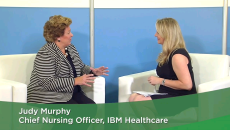
Judy Murphy, Chief Nursing Officer at IBM, discusses the growing influence of mobile technologies in healthcare analytics.
Electronic health records are typically touted as providing two primary and vital services: readily accessible patient records and protection against contraindicated medications. But Intermountain Healthcare is benefiting from a growing and transformative versatility in the application of its EHRs.
It’s a futuristic idea to be sure: Harnessing the intelligence of IBM Watson, the Jeopardy-winning supercomputer, to support cardiac-care recovery, reduce hospital readmissions, and save healthcare costs.
But that’s what the Colorado-based healthcare nonprofit Centura Health and consumer enterprise platform vendor Welltok are doing right now with CaféWell Concierge, currently in pilot with consumers who are transitioning back to everyday life after experiencing a heart condition.
See all of our HIMSS16 previews
“Cognitive computing mimics the way humans think by combining artificial intelligence and machine-learning algorithms,” said Jeff Margolis, CEO of Welltok. “IBM Watson understands natural language in context; it can determine the intent of a phrase or question and provide a pertinent, useful response.”
Margolis, along with Pam Nicholson, senior vice president of strategy for Centura Health, will present “Applying Cognitive Computing to Population Health” at HIMSS16.
Nicholson said that the technology the companies are piloting learns from interactions to provide personalized recommendations over time. For example, if a consumer has opportunities to join a team activity challenge and schedule a one-on-one coaching session, and consistently chooses the team activity, the app would recognize that this person favors social activities and recommend a support group at the local community center.
[Also: IBM Watson picked to help tackle heart disease]
Among the other ways that patients interact with CaféWell: Finding options for cardiac rehabilitation exercises and activities; researching new heart-healthy recipes and dishes at local restaurants, and identifying educational resources and videos on living with heart conditions.
In these ways, cognitive computing is broadening the scope of healthcare delivery “so that it can happen outside what we normally think of as the healthcare setting,'” Nicholson said. “The contrast with traditional health care, where we only get to interact with the consumer when they step inside our four walls and temporarily become a patient, is profound.”
As the real-world pilot users continue to train the application’s “brain,” as Margolis put it, these innovators see ample opportunities for cognitive computing to have an impact in the four areas of health: healthy behaviors, genetics, medical interventions, and environment.
[Like Healthcare IT News on Facebook]
“In five years, we believe that predictive analytics will further evolve and enable providers and consumers to make better health decisions while allowing for care to be highly personalized,” Nicholson said. “This will require us to continue to build solutions that incorporate timely and new data sources, offer reliable, consistent predictive models, deliver convenient and immediate personalized health and lifestyle recommendations, and learn intuitively and rapidly.”
The session "Applying Cognitive Computing to Population Health,” is slated to take place March 3, 2016 from 1 to 2 p.m. in Rock of Ages Theater at the Sands Expo Convention Center.
Twitter: @HenryPowderly
This story is part of our ongoing coverage of the HIMSS16 conference. Follow our live blog for real-time updates, and visit Destination HIMSS16 for a full rundown of our reporting from the show. For a selection of some of the best social media posts of the show, visit our Trending at #HIMSS16 hub.
The consultant, which proposes moving away from evaluating physicians independently to a methodology in which physicians are evaluated in clusters, will share insights at HIMSS16.